India aims to conquer the world with the Ramayana epic

Namit Malhotra is quite relaxed when talking about the feature film Ramayana, into which he is sinking $500 million. In an interview with CNN at his London office, the producer stated frankly that he is not overly concerned with profit calculations or box-office recoupment.
"If we don't make money from the film, we'll make it from merchandise. If merchandising doesn't succeed, we'll do it through the theme park. If the theme park doesn't turn a profit, we'll find another way," he shared.
For Namit Malhotra, Ramayana is first and foremost the story of Lord Rama, one of the most revered figures in Hinduism. He believes that a work executed with care, based on such a deeply influential story, is unlikely to fail commercially.
Ramayana is a 2,000-year-old epic poem believed to have been composed by the sage Valmiki. The work tells the story of Rama, the divine prince who sets out to defeat Ravana, a demon king whose ambition and power threaten the gods.
The story has become a part of the cultural and religious heritage cherished by generations of Indians. The epic has been adapted into various formats, most notably a beloved television series in the 1980s. However, no previous version has been produced on such a large scale with a global audience-oriented approach as this current project.

With a total budget of around $500 million for the two parts, Ramayana is currently the most expensive film project in Indian history. An average investment of $250 million per part puts the work in the same tier as large-scale Hollywood blockbusters, particularly Marvel cinematic franchises.
Notably, the crew also features composers Hans Zimmer and A.R. Rahman. DNEG handles the visual effects, leveraging experience from large-scale projects like The Odyssey and Dune: Part Three.
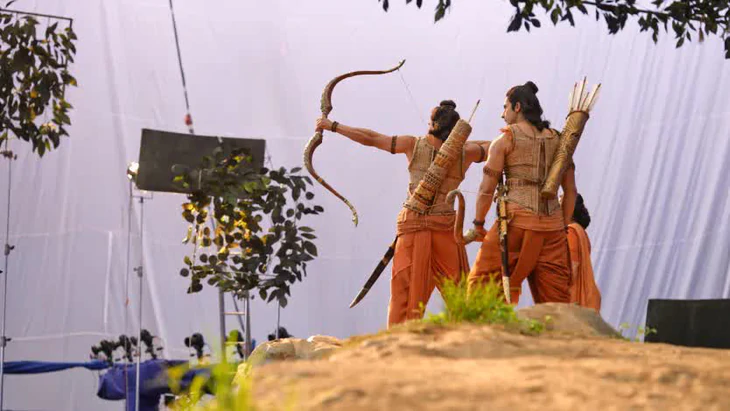
On the international market, Ramayana is presented as India's answer to blockbuster film franchises like Avatar or The Lord of the Rings. However, unlike many fantasy blockbusters, the project must handle particularly sensitive material: a religious story tied to the beliefs of billions of people.
Director Nitesh Tiwari stated that both he and Namit Malhotra are practicing Hindus. According to him, the production team must exercise extreme caution when adapting a work of such profound significance to the public.
This challenge is not without precedent. In 2023, the high-budget action film Adipurush, also inspired by Ramayana, failed at the box office amid a wave of public backlash.

Ramayana is being released at a time when global cinema is witnessing a strong resurgence of epic and mythological stories. Christopher Nolan's The Odyssey, adapted from Homer's epic poem, has captured audience attention this year.
Meanwhile, the Chinese animated film Ne Zha 2 became the highest-grossing film globally in 2025, pulling in $2.2 billion in the domestic market alone. These successes somewhat reinforce the producers' confidence in the appeal of indigenous cultural stories when backed by proper investment.
Previously, the global box-office record for Indian cinema belonged to Dangal (2016), with $304 million, of which the Chinese market alone contributed 64% of total revenue. Therefore, the prospect of Ramayana securing a release in that country could significantly impact the film's commercial outlook.